
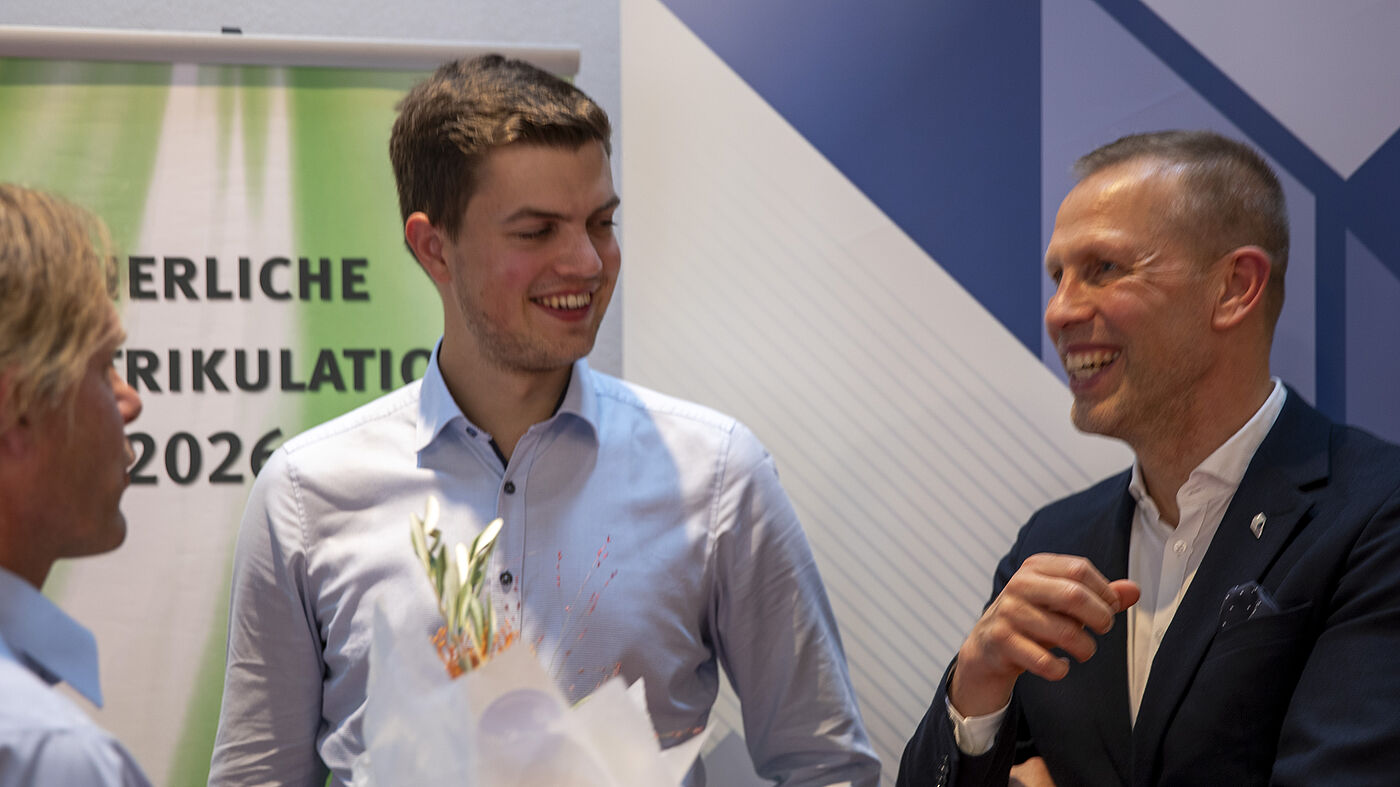

During our Wismar University of Applied Sciences’ matriculation ceremony, Steffen Güll, a member of the Executive Board of the Mecklenburg-Western Pomerania Chamber of Engineers, presented the award and the prize money of 500 euros to Lukas Burmeister, M.Eng.
Burmeister completed his Master’s degree in ‘Mechatronics’ under the supervision of Prof. Dr Thilo Moshagen with the outstanding mark of 1.0. His excellent Master’s thesis focused on the ‘testing of DoE-based modelling approaches for a fuel cell stack, particularly with a view to optimising operational behaviour’, which was carried out in collaboration with the Schwerin-based company Baltic Fuel Cells.
In his thesis, Burmeister investigated how the performance of a fuel cell stack varies as a function of different operating parameters. Based on measurements, he developed polynomial surrogate models as well as models based on neural networks and used these to determine optimal operating parameters. In addition, he employed a novel bisection algorithm, the Knaster algorithm, for the optimisation. In his thesis, Burmeister investigated how the performance of a fuel cell stack varies as a function of various operating parameters. Based on measurements, he developed polynomial models and models based on neural networks, and used these to determine optimal operating parameters. In addition, he employed a novel bisection algorithm, known as the Knaster algorithm, for the optimisation process. The thesis combines mathematical methods and modern algorithms with their implementation in Python, practical measurements, and the development and construction of a test bench. It thus covers a broad spectrum, ranging from theoretical foundations to practical application.
Prof. Dr Thilo Moshagen, who supervised Burmeister on his Master’s thesis, highlighted not only his academic achievements but, in particular, his consistent and dedicated approach to his work. Even whilst still an undergraduate, Burmeister impressed with his interest, helpfulness and strong academic performance, and was also actively involved as a student assistant and in coursework and final-year projects.
With this award, the Mecklenburg-Western Pomerania Chamber of Engineers recognises not only a technically demanding final-year project, but also the commitment and exceptional approach of a young engineer.